
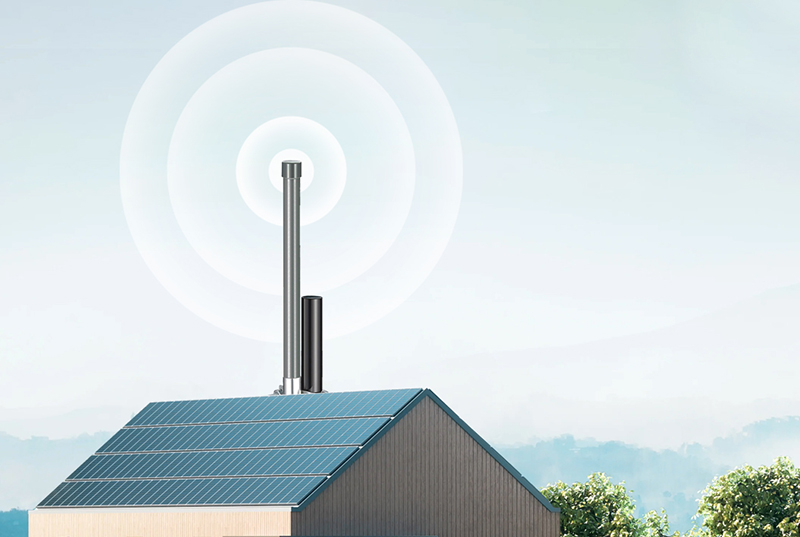
A directional flat panel antenna (also called a flat directional antenna) is an antenna that achieves directional signal transmission and reception through a specific structural design. Its working principle is based on the directional radiation and reception characteristics of electromagnetic waves. The core is to enhance the signal strength in a specific direction by "focusing" energy while suppressing interference in other directions. The following is a detailed analysis from three levels: structural design, working mechanism and key principles:
1. Core structural design
The structure of a directional flat panel antenna determines its directional characteristics. The typical structure includes the following key parts:
Radiating unit: usually composed of a metal patch (such as copper foil), etched on an insulating substrate (such as FR4, polytetrafluoroethylene), forming a structure similar to a "vibrator", responsible for the radiation and reception of electromagnetic waves.
Reflector: A metal plate (usually aluminum or steel) located behind the radiating unit. Its function is to reflect electromagnetic waves, prevent energy from radiating to the rear of the antenna, and enhance the focusing effect of the front signal.
Feed network: The line (such as microstrip line) connecting the radiating unit and the RF module is responsible for converting electrical signals into electromagnetic waves (when transmitting) or vice versa (when receiving), and matching impedance to reduce signal loss.
Shell: Usually made of plastic or metal, it protects the internal structure and is waterproof and dustproof. Some models will integrate a low-noise amplifier (LNA) to improve receiving sensitivity.

2. Working principle: Directional focusing of electromagnetic waves
The core principle of directional flat-panel antennas is to concentrate the energy of electromagnetic waves in a specific direction (usually a narrow angle range in front of the antenna) through structural design, rather than omnidirectional radiation. The specific process is as follows:
When the signal is transmitted: Directional energy radiation
When the radio frequency current passes through the radiating unit (metal patch), it will excite electromagnetic waves. Due to the presence of the reflector, the electromagnetic waves radiated to the rear of the antenna are reflected back to the front, forming a "phase superposition" with the electromagnetic waves radiated directly in front - that is, the peaks of the two beams meet each other, and the energy is enhanced; while the electromagnetic waves in other directions (such as the side) are weakened due to phase cancellation or shielding by the reflector.
In the end, most of the energy is concentrated in a conical area in front of the antenna (that is, the "main lobe" direction), achieving directional radiation.
When receiving signals: Directional gain enhancement
The receiving process is the opposite of the transmission: only the electromagnetic waves from the main lobe direction can be effectively received by the radiating unit, and the reflector will reflect the interference signals from the rear/side to reduce their impact on the main signal. At the same time, due to energy focusing, the antenna's signal receiving ability in a specific direction (i.e. "gain") is much higher than that of an omnidirectional antenna, and can receive weaker signals.

3. Key technologies: realization of directivity
The "directivity" of directional flat panel antennas is determined by the following technical characteristics:
Beam width: the angular range of the main lobe (usually expressed as horizontal/vertical beam width, such as 60°×30°). The narrower the angle, the stronger the directivity (the more concentrated the energy), but the smaller the coverage; conversely, the wider the angle, the larger the coverage, but the gain decreases.
Gain: a measure of the antenna's ability to concentrate energy in a specific direction, measured in dBi. The gain of a directional flat panel antenna is usually 8-20dBi (omnidirectional antennas are generally 2-5dBi). The higher the gain, the stronger the directivity and the longer the signal transmission distance.
Front-to-back ratio: the ratio of the signal strength in the main lobe direction to the opposite direction (rear), measured in dB, usually ≥25dB. The higher the front-to-back ratio, the stronger the ability to suppress rear interference (for example, a front-to-back ratio of 30dB means that the rear signal is attenuated 1000 times).
Summary
Directional flat-panel antennas use the "radiating unit + reflector" structural design and the principle of electromagnetic wave superposition and reflection to concentrate energy in a specific direction to achieve high-gain, highly directional signal transmission and reception. Its core advantage is to improve the communication distance and anti-interference ability in a specific direction, so it is widely used in scenarios that require long-distance directional communication (such as base station backhaul, drone image transmission, monitoring equipment networking, etc.).
